
 田中(あらいちゅー), 馬主で大家で占い師
Free Horoscope JSON Generator for AI Astrology | Western, Vedic & Four Pillars
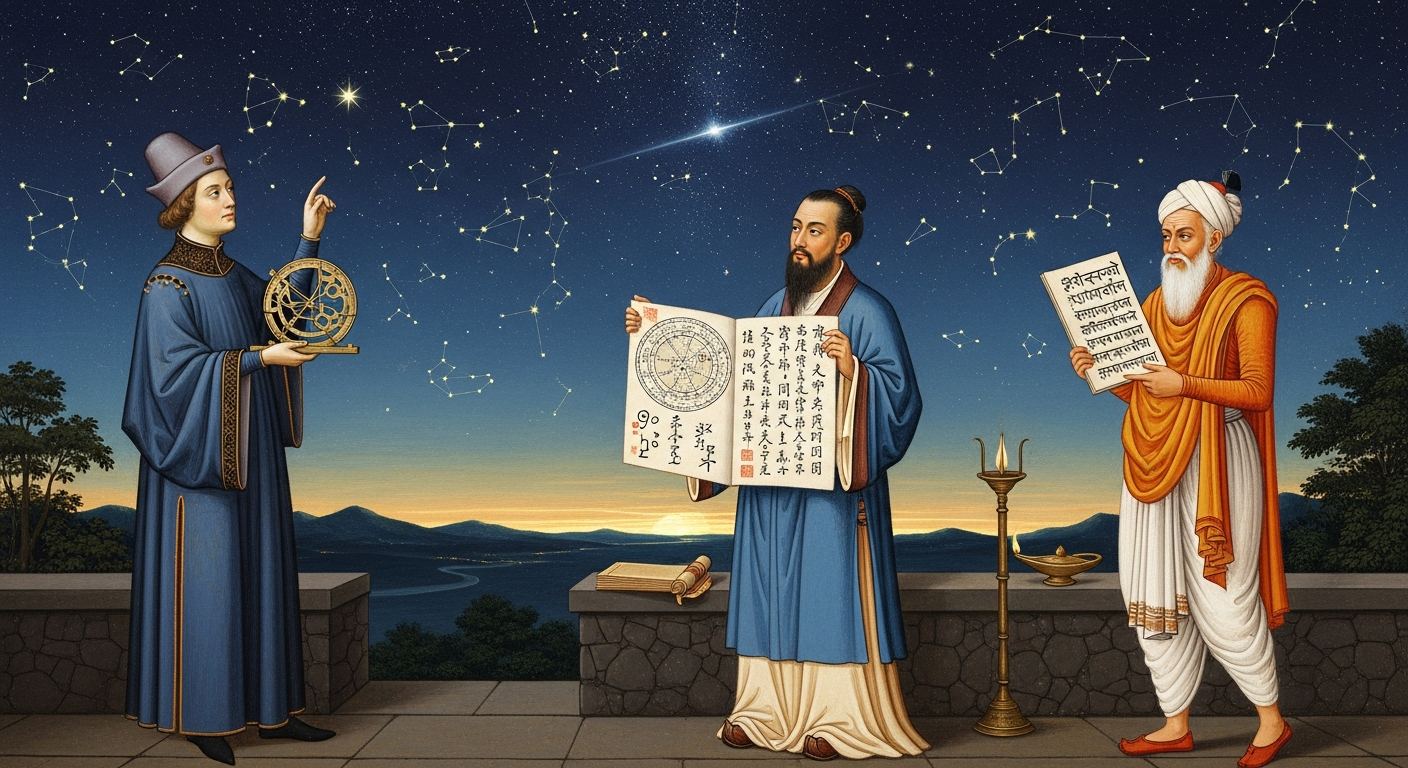
Create a precise horoscope from your birth data and export it as JSON to use with generative AI such as ChatGPT, Gemini, and Claude. In a single calculation this free tool produces three charts at once — a Western horoscope (Tropical zodiac / Placidus houses), a Vedic horoscope (Sidereal / Lahiri ayanamsha), and a Chinese Four Pillars (Sizhu / Bazi) chart. All calculation runs entirely in your browser, and no birth data is ever sent to a server.
Free birth chart calculator: Western, Vedic & Four Pillars from one form
Western, Vedic & Four Pillars — All-in-One Calculator
Enter your birth date, time, sex, and birthplace to instantly calculate three charts at once: a Western horoscope (Tropical / Placidus), a Vedic horoscope (Sidereal / Lahiri), and a Chinese Four Pillars (Sizhu) chart. Set your birthplace by Japanese prefecture or by latitude/longitude (worldwide).
Your birth data is safe。Your input is never sent to any server and is not saved to cookies or local storage. All calculations run entirely in your browser, and your data is cleared the moment you close the page.
Three astrology systems in one JSON, ready for AI
Most apps ask only for your birth date and let the AI guess the rest. This tool instead calculates your exact planetary longitudes, houses, aspects, dasha periods, and Four Pillars, and packages them into one structured JSON file. Feeding that high-quality data to an AI lets it analyze you on a precise foundation — and combining three traditions in one file enables a genuine multi-system reading.
Read your horoscope with AI (ChatGPT / Gemini / Claude)
After you generate your chart, download or copy the JSON, paste it into your favorite AI, and ask it to interpret your love life, career, yearly outlook, or compatibility. Because the AI works from accurate astronomical data rather than guesswork, the reading is far more specific and convincing.
Ready-made prompts are available on our AI astrology prompt collection — copy a prompt for overall life, love, career, compatibility, or marriage readings, then paste it with your JSON. Want proof it works? See our blind AI readings of Steve Jobs & Princess Diana.
How to use (5 steps)
- Enter your birth date, time, sex, and birthplace. Outside Japan, choose the “Latitude / Longitude” mode and enter your coordinates (a lookup link is provided in the form).
- Click Calculate to compute all three charts at once.
- Copy or download the JSON from the result area.
- Paste the JSON into ChatGPT, Gemini, or Claude.
- Send a prompt asking for the reading you want, and the AI generates a personalized interpretation.
The three systems: Western, Vedic & Four Pillars
Western Astrology (Tropical / Placidus)
The tropical zodiac with Placidus houses — Sun, Moon, the planets, Ascendant and Midheaven, major aspects, and classical aspect patterns (Stellium, Grand Trine, T-Square, Yod, and more). Every chart also includes Chiron and the four main asteroids (Ceres, Pallas, Juno, Vesta), the Black Moon Lilith, the Vertex / Anti-Vertex and the Part of Fortune — there is nothing to switch on. See asteroids and sensitive points below.
Vedic Astrology (Sidereal / Lahiri / Jyotish)
The sidereal zodiac with the Lahiri ayanamsha — Rashis, Nakshatras and padas, Vimshottari Dasha, Ashtakavarga, Shadbala, and the notable yogas of Jyotish.
Four Pillars of Destiny (Sizhu / Bazi)
The Chinese four-pillar chart — Heavenly Stems and Earthly Branches, hidden stems (three methods), Ten Gods, the Twelve Stages, luck pillars, and annual pillars, with both the Teiki and Koki solar-term methods shown side by side.
Asteroids and sensitive points: Juno, Chiron, Lilith, the Vertex and the Nodes
Most free birth chart calculators stop at the ten classical bodies. This one always goes further, and there is nothing to switch on: every chart and every JSON export carries the asteroids and sensitive points below with their zodiac sign, exact degree and house, together with their aspects to the rest of the chart.
Juno — the marriage and commitment asteroid
Juno (⚵, asteroid 3 Juno) is read as the signature of long-term partnership: what you need from a committed relationship, and what you are prepared to commit to in return. To find your Juno sign, degree and house, fill in the form at the top of this page and press Calculate. Juno is listed in the Western chart table beside the planets, and appears in the JSON under the Juno key.
The JSON also records Juno’s aspects — a Juno conjunct Saturn or a Jupiter trine Juno, for instance — so an AI can interpret your Juno placement in the context of the whole chart instead of reciting a generic sign meaning.
Chiron, Ceres, Pallas and Vesta
Chiron (⚷) is the wounded healer: the sore spot you keep returning to, and the place where you end up helping others. Ceres (⚳) describes how you nurture and how you want to be cared for, Pallas (⚴) your pattern recognition and strategy, and Vesta (⚶) what you quietly devote yourself to.
These are not rough estimates. Chiron is evaluated from a piecewise Chebyshev fit and agrees with JPL Horizons to about 0.06 arcsecond; the four main-belt asteroids use multi-epoch osculating elements and stay within 0.45 arcminute across 1800–2099.
North Node and South Node (Rahu and Ketu)
The Western chart gives the Mean North Node (☊) with its sign, degree and house. The South Node needs no separate calculator: it is by definition the point exactly 180° opposite, the same axis read from the other end.
The Vedic chart states both ends explicitly as Rahu (north) and Ketu (south), computed from the True Node, each with its rashi, nakshatra and house. Ketu also opens the Vimshottari Dasha cycle, so it appears at the head of your dasha timeline.
Vertex and Anti-Vertex
The Vertex (Vx) is where the ecliptic crosses the western prime vertical, often read as an axis of encounters that arrive from outside your own initiative; the Anti-Vertex is the opposite point. It is derived geometrically from your RAMC, birth longitude and the obliquity of the ecliptic, which makes it unusually sensitive to birth time and place — a few minutes of error moves it noticeably.
Part of Fortune and Part of Spirit
The Arabic parts are calculated with automatic day/night sect detection, so the day and night formulae are applied correctly rather than blindly. Both the Part of Fortune (⊗) and the Part of Spirit are shown, and the sect used is stated in the result so you can check it against your own school.
Black Moon Lilith
This tool reports the Mean Black Moon Lilith (⚸) — the Moon’s mean apogee, the convention used by astro.com and many online charts. It is not the True (osculating) Lilith favoured by Solar Fire and some other software, which can differ by as much as 30°, and it is not the asteroid Lilith (1181). Our mean value can also differ from Swiss Ephemeris by up to roughly 10 arcminutes, so if you work with Sabian symbols it is worth checking the neighbouring degree as well.
Accuracy & sources (Swiss Ephemeris-grade)
Planetary positions are computed with the open-source Astronomy Engine (MIT, Swiss Ephemeris-grade) plus Jean Meeus’ published formulae, to arc-second precision. The data is accurate enough to use as the foundation for serious AI-assisted readings.
Frequently asked questions (FAQ)
Nothing happens when I paste a long prompt into Claude on a computer
On the Claude desktop app and the Claude web app on a computer, a long block of pasted text becomes an attachment labelled PASTED instead of staying in the message box. When that happens Claude sees an empty question, so it may only inspect the JSON and stop there.
You do not need to shorten your prompt. Paste it as usual, then type one short line in the message box:
Follow the attached prompt and read my chart using the attached JSON.
Claude will then read both the prompt and the JSON and begin the reading. This rarely happens in the Claude smartphone app.
The AI says the data is truncated, or that it cannot read the second half
The file is not broken. This is about how the AI loads attachments, so please try the following in order.
- Open a brand-new chat and attach the JSON again. Continuing an existing chat can carry over the earlier partial read.
- With ChatGPT, users report that switching between the browser version and the app, or between phone and computer, resolves it.
- If it still happens, please try Claude, Gemini or Grok.
Can I use this with a free AI plan?
The free plans of Claude, Gemini and Grok handle the amount of data in this JSON without trouble.
On ChatGPT’s free plan, only the beginning of an attachment is loaded automatically and the rest is not consulted unless the AI fetches it itself, so it may tell you that data is missing. In that case try the steps in the previous question, or use Claude or Gemini.
The size of the file is rarely the problem. When an AI cannot read it, the cause is how the AI loads the file, not how large it is.
How do I find my Juno sign and house?
Fill in the form at the top of this page and press Calculate. Juno is listed in the Western chart table with its sign, degree and house, and it is included in the downloadable JSON as well. There is no separate Juno calculator to run and no option to enable — see Juno above.
Why are my degrees, houses, or ASC/MC different from other software?
This is not a bug. Results vary with the house system, ayanamsha, time-zone handling, and rounding. This tool uses the tropical zodiac with Placidus houses for the Western chart and the Lahiri ayanamsha for the Vedic chart.
What if I don’t know my birth time?
You can still use the tool; it will compute with 12:00 noon as a fallback. Note that the Moon position, Ascendant, and the hour pillar become less accurate without an exact time.
Can it calculate charts for people born outside Japan?
Yes. Switch to “Latitude / Longitude” mode and enter your coordinates and UTC offset. A coordinate-lookup link (LatLong.net) is provided right in the form.
Why do Western, Vedic, and Four Pillars give different results?
Each tradition uses a different zodiac, calendar, and symbolic framework, so they emphasize different things. That is exactly why combining all three in one JSON lets an AI cross-reference them for a richer, multi-angle reading.
What are Rahu and Ketu?
They are the Moon’s north and south nodes (the Dragon’s Head and Tail) in Vedic astrology, treated as shadow planets with strong karmic significance.
Which “solar-term method” is correct for the Four Pillars — Teiki or Koki?
Both are valid traditions for determining the month boundary; schools differ. This tool shows both side by side so you can compare.
Why are there three hidden-stem (Zokan) methods?
Different Four Pillars schools assign the hidden stems within each Earthly Branch differently. The tool shows the monthly-division, commanding, and main-only methods so you can follow your preferred school.
What is the “required ratio” in Shadbala?
Shadbala measures the six-fold strength of each planet in Vedic astrology; the required ratio compares a planet’s total strength against the minimum considered strong.
Is my input sent to a server?
No. All calculation runs entirely in your browser, and your birth data is never sent to any server. When you use the JSON with an AI, you paste it yourself.
How do I use the resulting JSON with ChatGPT, Gemini, or Claude?
Copy or download the JSON, paste it into the AI chat, then ask for the reading you want (for example, “Based on this data, read my love life”). The JSON keys are in English so any AI can parse them.
I want to understand the meaning of each planet and point (ASC, MC, house cusps).
See our complete planet & point guide (in Japanese), which compares how Western and Vedic astrology interpret each body and sensitive point.
What is Western astrology? What is a horoscope?
Western astrology interprets the positions of the Sun, Moon, and planets along the tropical zodiac at the moment of birth. A horoscope (natal chart) is the resulting map of those positions across the twelve houses.
Can it show a bi-wheel chart or transits?
The JSON can include current transit positions (you can toggle this in the form), letting an AI discuss your current outlook in addition to the natal chart.
Privacy & notes
- All calculations run in your browser; no birth data is transmitted or stored.
- AI readings are for entertainment and reference only — do not rely on them for medical, legal, or financial decisions.
- Results are reference values based on astronomical algorithms; schools and calendar systems differ.
Related pages
- AI astrology prompts for ChatGPT, Gemini & Claude (English)
- Sample: AI reads Steve Jobs & Princess Diana — blind (English)
The following companion pages are written in Japanese.
- 3-system horoscope & AI JSON tool (Japanese)
- AI astrology prompt collection (Japanese)
- Planet & point meanings — complete guide (Japanese)
- What is “JSON fortune-telling”? (Japanese)
- Purple Star Astrology (Zi Wei Dou Shu / ZWDS) chart calculator (Japanese)
Prefer a face-to-face reading? Visit us in Tokyo
Want a real, in-person reading in English or Thai? At our Uranai Salon Chance (Koenji, Tokyo), Tamaki — a bilingual fortune teller and a native English and Thai speaker — offers tarot, palmistry, Burmese astrology (Mahabote) and Thai spiritual readings. ¥5,500 for 30 minutes, 2 minutes from JR Koenji Station.
อยากดูดวงแบบเจอตัวจริงเป็นภาษาไทยหรืออังกฤษไหม? พบอาจารย์ทามากิ (เจ้าของภาษาไทยและอังกฤษ) ที่ร้านดูดวง Chance ย่านโคเอ็นจิ โตเกียว — ดูโปรไฟล์และจองคิว